Video transcript

You know, we talk to a lot of people about exchange rates. One question we get all the time is where rates are going to go. First thing I want to be clear about here is that Bound is not in the business of trying to predict where rates are going to go.

But one question that comes up a lot is what should be the default assumption? Where exchange rates will go if I want to assume nothing in terms of changes in supply and demand, volatility and global macroeconomic changes.

So I want to talk a little bit about how Bound thinks about that. First thing I want to be clear about is what Bound is in the business of doing. Of course, we help companies make their foreign cash flows more stable and predictable.

So if you have unbound cash flows, so cash flows that just bounce around with the exchange rates, you can use one of our three automated programs to make those cash flows more stable and predictable.

With Forwarding you can lock the rate for a period of time. With Averaging you can move to a slow, trending, trailing average. And then with Ranging you can put in control barriers to make sure it keeps the rate inside a certain range.

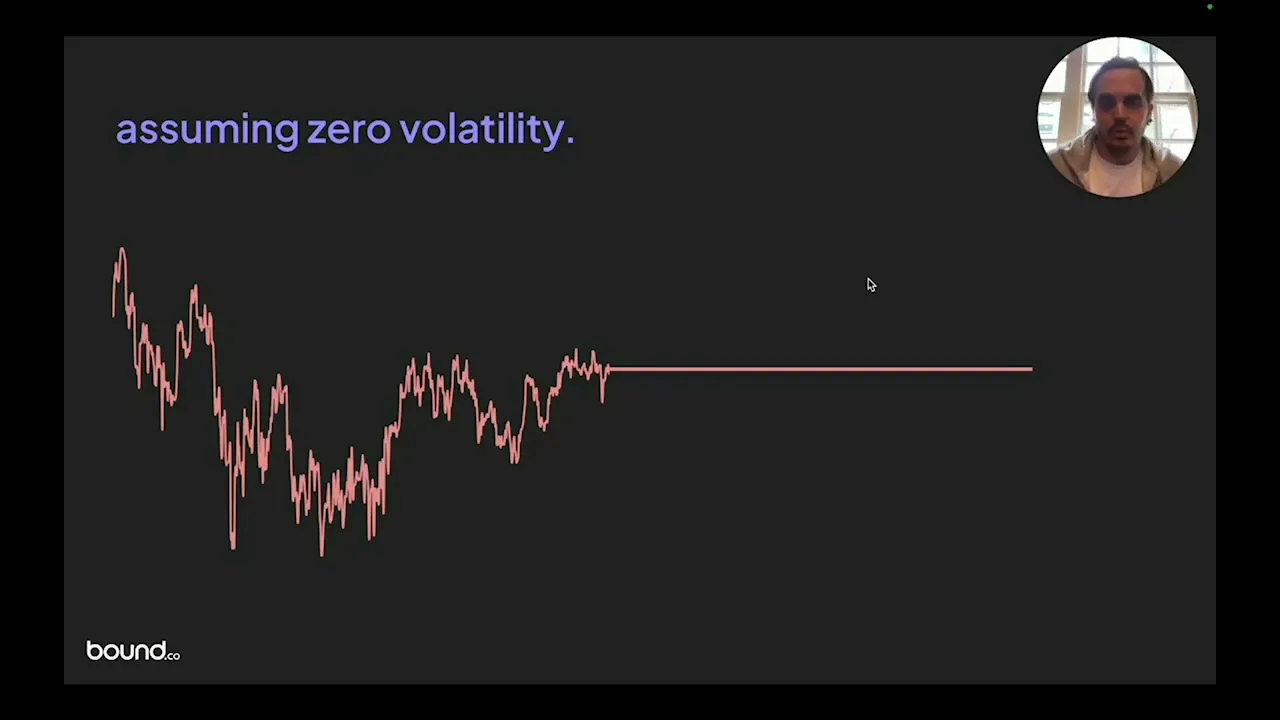
That's what you can do with Bound. But let's get to the main question at hand here, which is, what should the assumption be if I assume zero volatility? A lot of people assume it's going to be the same.

So rates have been moving around over the last couple of years and I know it's not going to stay the same as we go into the future but because I can't predict it I'm just going to assume that it's going to stay the same. Because it's just as likely to go up as it is to go down, so that's my safest assumption.

That ignores one really important principle, which is the interest rate on the two currencies and that creates what's called the forward curve. So let's pretend we're doing a trade today, dollars for euros, and then a year from now we're trading those back. So current exchange rate today is about 110, so we would change 110 dollars for 100 euros.

If the interest rates on those two currencies were exactly the same, we would just swap that money back. But since the dollar earns more interest over the course of the year, we can't just swap those back and have that be fair, or whoever got the dollars on January 1st is in a way better position.

So what we do instead is to take into consideration the interest earned over the course of the year and the exchange rate needs to change. So in this example, the 110 becomes 115. The 100 euros becomes 103. The exchange rate needs to move, needs to move from 110 to 1.1214 to compensate for that small difference.

So that is the essence of the forward curve. Let's take a look at a couple of real forward curves here. And again, this is the assumption that this is not about volatility. This is not about if the economy is going to strengthen or anything. This is just today's exchange rate and the adjustment we need to make for the fact that these currencies have different interest rates on them.

So you can see Pound<>Euro is going to dip a little bit, Dollar<>Swedish Krona is going to stay pretty level but come down, Euro<>USD and USD<>Brazilian Real are both going to go up. Because the Brazilian Real is quite a high interest rate currency relative to US dollars. And so this is almost a 5 percent adjustment over the course of the next 12 months, in where that exchange rate will go strictly because of the interest rate.

So if supply and demand don't change, if the economies of the US and Brazil stay exactly the same, there's nothing else that changes. This is where a rational person would assume, just based on the interest rates, where this exchange rate would change.

That could be good for me or bad for me, depending on if I'm buying or selling BRL. Some people assume that this is a cost of hedging, saying, if I hedge the rate out a year from now that rate could be potentially a lot worse for me. So I'm not going to hedge at all, I'm just gonna assume that it's gonna be flat.

But assuming that it's flat is essentially making the assumption that it's going to be volatile and it's going to be volatile in the right direction to hold that flat because you'll be fighting against the interest rate differences across these two currency pairs over the course of that whole year.

The way bound tends to think about volatility and exchange rates is the default assumption is the forward curve itself and volatility revolves not around a flat line, but around the forward curve.

Stay up to date with insights

Enhance your finance skills by learning from our network of top industry experts

Over 200 fast-growing companies use Bound to manage their foreign currency

Curious to discover why?

Currency hedging technology with unrivalled speed and flexibility

© 2026 Bound. All rights reserved.

All testimonials, reviews, opinions, and case studies displayed on this website are provided for illustrative purposes only and do not represent the experience of all customers. Individual outcomes may vary depending on personal circumstances, products used, and market conditions. Past or representative results are not a guarantee of future performance.

Bound Rates Limited is a company registered in England and Wales (Company No. 13036275) with its registered office at 16 Great Chapel Street, London W1F 8FL.

Bound Rates Limited (FRN 966723) is authorised and regulated by the Financial Conduct Authority as an investment firm. Bound is also authorised by the Financial Conduct Authority as an Electronic Money Institution (FRN: 1036025).

The regulatory status of individual products and services may vary. Customers should review their account terms and contractual documentation to understand which services are regulated and whether they are eligible for protection under the Financial Services Compensation Scheme (FSCS).

Where applicable, eligible client money related to regulated FX hedging is protected by the FSCS up to £120,000 per eligible customer, per authorised institution. Check your eligibility at https://www.fscs.org.uk/making-a-claim/claims-process/eligibility-rules/ 

Funds relating to our e-money business are safeguarded in segregated accounts in accordance with regulatory requirements. Electronic money accounts are not deposits and are not covered by the FSCS.

The information on this website does not constitute an offer, solicitation, or marketing of products or services to persons outside the United Kingdom. Access to this website from outside the United Kingdom does not constitute solicitation or marketing.

Over 200 fast-growing companies use Bound to manage their foreign currency

Curious to discover why?

Currency hedging technology with unrivalled speed and flexibility

© 2026 Bound. All rights reserved.

All testimonials, reviews, opinions, and case studies displayed on this website are provided for illustrative purposes only and do not represent the experience of all customers. Individual outcomes may vary depending on personal circumstances, products used, and market conditions. Past or representative results are not a guarantee of future performance.

Bound Rates Limited is a company registered in England and Wales (Company No. 13036275) with its registered office at 16 Great Chapel Street, London W1F 8FL.

Bound Rates Limited (FRN 966723) is authorised and regulated by the Financial Conduct Authority as an investment firm. Bound is also authorised by the Financial Conduct Authority as an Electronic Money Institution (FRN: 1036025).

The regulatory status of individual products and services may vary. Customers should review their account terms and contractual documentation to understand which services are regulated and whether they are eligible for protection under the Financial Services Compensation Scheme (FSCS).

Where applicable, eligible client money related to regulated FX hedging is protected by the FSCS up to £120,000 per eligible customer, per authorised institution. Check your eligibility at https://www.fscs.org.uk/making-a-claim/claims-process/eligibility-rules/ 

Funds relating to our e-money business are safeguarded in segregated accounts in accordance with regulatory requirements. Electronic money accounts are not deposits and are not covered by the FSCS.

The information on this website does not constitute an offer, solicitation, or marketing of products or services to persons outside the United Kingdom. Access to this website from outside the United Kingdom does not constitute solicitation or marketing.

Over 200 fast-growing companies use Bound to manage their foreign currency

Curious to discover why?

Currency hedging technology with unrivalled speed and flexibility

© 2026 Bound. All rights reserved.

All testimonials, reviews, opinions, and case studies displayed on this website are provided for illustrative purposes only and do not represent the experience of all customers. Individual outcomes may vary depending on personal circumstances, products used, and market conditions. Past or representative results are not a guarantee of future performance.

Bound Rates Limited is a company registered in England and Wales (Company No. 13036275) with its registered office at 16 Great Chapel Street, London W1F 8FL.

Bound Rates Limited (FRN 966723) is authorised and regulated by the Financial Conduct Authority as an investment firm. Bound is also authorised by the Financial Conduct Authority as an Electronic Money Institution (FRN: 1036025).

The regulatory status of individual products and services may vary. Customers should review their account terms and contractual documentation to understand which services are regulated and whether they are eligible for protection under the Financial Services Compensation Scheme (FSCS).

Where applicable, eligible client money related to regulated FX hedging is protected by the FSCS up to £120,000 per eligible customer, per authorised institution. Check your eligibility at https://www.fscs.org.uk/making-a-claim/claims-process/eligibility-rules/ 

Funds relating to our e-money business are safeguarded in segregated accounts in accordance with regulatory requirements. Electronic money accounts are not deposits and are not covered by the FSCS.

The information on this website does not constitute an offer, solicitation, or marketing of products or services to persons outside the United Kingdom. Access to this website from outside the United Kingdom does not constitute solicitation or marketing.